
Saudi Arabia’s drive to find additional security partners has become increasingly urgent. On 26 September, the Saudi-led coalition said it had intercepted two Houthi ballistic missiles targeting Khamis Mushait and two drones heading towards Riyadh. The attacks came a day after the military chiefs of Saudi Arabia, Türkiye and Pakistan met in Riyadh to discuss closer defence cooperation. They also follow repeated Houthi strikes on Saudi cities and energy infrastructure, including the strategically important Yanbu area. With the Strait of Hormuz still heavily disrupted, Yanbu and the East–West Pipeline have become central to Saudi Arabia’s ability to export crude without relying on the Gulf chokepoint.
For Riyadh, therefore, the Yemen conflict is no longer only about containing the Houthis. It now intersects with homeland defence, energy security and freedom of navigation through the Red Sea. Houthi advances along Yemen’s western coast and towards Bab al-Mandab have strengthened the movement’s ability to threaten shipping and to raise insurance and freight costs. The concern is compounded by disruption at Hormuz: instability at both chokepoints would expose global energy and trade flows to simultaneous pressure.
What has unsettled Saudi calculations is Washington’s reluctance to resume a direct military campaign against the Houthis. Saudi and Yemeni requests for stronger American military action have not led to a commitment to renewed US strikes. Washington has nevertheless reaffirmed its broader defence relationship with Riyadh and remains deeply involved in Gulf security. This is not an American withdrawal from Saudi security, but a reluctance to assume the burden of the Red Sea and Yemen on the terms Riyadh would prefer.
Saudi Arabia has responded by broadening its circle of operational partners. Britain has agreed to provide an RAF Voyager air-to-air refuelling aircraft for Saudi defensive operations, building on existing British air-defence support. France has announced troops, radar and defensive systems to help protect Yanbu, the Kingdom’s principal Red Sea energy outlet. European governments are also considering stronger naval protection for commercial shipping.
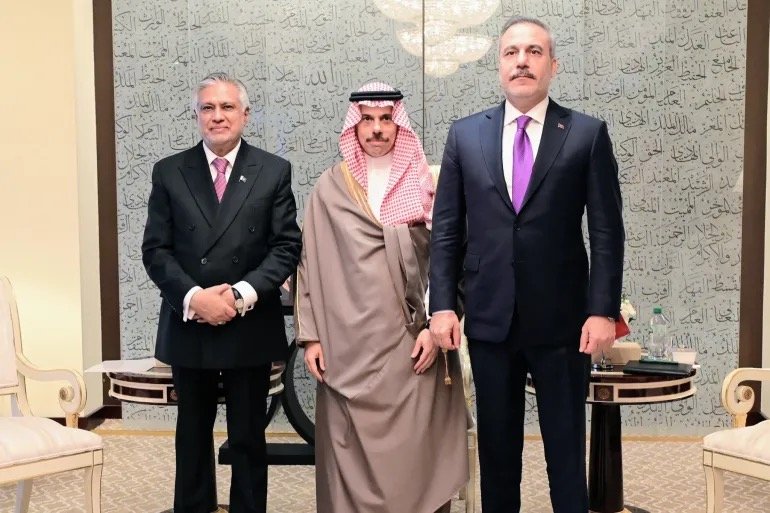
Meanwhile, the Makkah Joint Defence Agreement among Saudi Arabia, Türkiye and Pakistan is moving from declaratory deterrence to practical coordination. Its public formula is deliberately NATO-like — an ‘Article 5’ principle in political shorthand: an armed attack on one member is to be regarded as an attack on all, consistent with Article 51 of the UN Charter. On 25 September, the three countries’ military chiefs agreed to strengthen intelligence sharing, military coordination and capability integration, while their foreign ministers began work on the agreement’s secretariat, committees and working groups.
Yet the comparison with NATO should not be pushed too far. No publicly known integrated command, standing force, or automatic response mechanism exists. The partners also face different threat landscapes and have distinct relationships with Iran. Ankara balances competition with dialogue, whereas Islamabad shares a long border with Iran and has repeatedly preferred mediation to confrontation. The real test is what each partner is prepared to do if Saudi Arabia comes under attack.
Pakistan illustrates this ambiguity most clearly. Its separate Strategic Mutual Defence Agreement with Saudi Arabia, signed in September 2025, provides that aggression against either country will be treated as aggression against both. Missile or drone attacks on Saudi territory can therefore fall within the pact’s defensive logic. However, nothing indicates that it automatically obliges Pakistan to conduct offensive operations inside Yemen. Air defence, intelligence sharing, training and the protection of Saudi territory are easier to reconcile with the agreement than participation in a campaign to seize Yemeni territory. Pakistan’s refusal to join the Saudi-led intervention in 2015, while affirming support for Saudi territorial integrity, remains the most relevant precedent.
The UN General Assembly has added an important diplomatic dimension. Saudi Foreign Minister Prince Faisal bin Farhan explicitly linked Gulf and Red Sea security to global energy markets and supply chains, calling for guaranteed freedom of navigation through Hormuz, Bab al-Mandab, the Red Sea, and the Gulf of Aden. Pakistan has stressed that the Makkah pact is defensive and not directed against any other country. Yemen’s internationally recognised government has argued that restoring state authority and securing Bab al-Mandab are inseparable objectives. Around 80 countries have also condemned attacks threatening Saudi Arabia and international shipping and have called for safe navigation.
This widening consensus helps Riyadh, but it also reveals a limit. There is broad agreement on defending international waterways, but there is much less appetite for becoming another combatant in Yemen. Oman continues to provide channels to the Houthis, while other regional and international actors are pressing Iran to support de-escalation. Diplomacy around Hormuz also matters, as easing the wider Iran confrontation would reduce pressure on Saudi Arabia’s eastern flank.
Saudi Arabia’s emerging security architecture should therefore be understood not as a replacement for the United States but as insurance against overreliance on a single protector. Britain can provide operational support, France can help defend critical infrastructure, Türkiye can offer technology and military capacity, Pakistan can add strategic depth and longstanding defence cooperation, and European naval forces can protect shipping.
The harder question is whether these arrangements can secure Bab al-Mandab without drawing their participants into another open-ended war in Yemen. Riyadh is trying to internationalise the defence of navigation while keeping the conflict itself politically containable. That balance — collective protection of Saudi territory and global trade without recreating the 2015 intervention — will determine whether Saudi Arabia’s new security network becomes a durable regional architecture or merely an emergency coalition assembled under fire.
***

