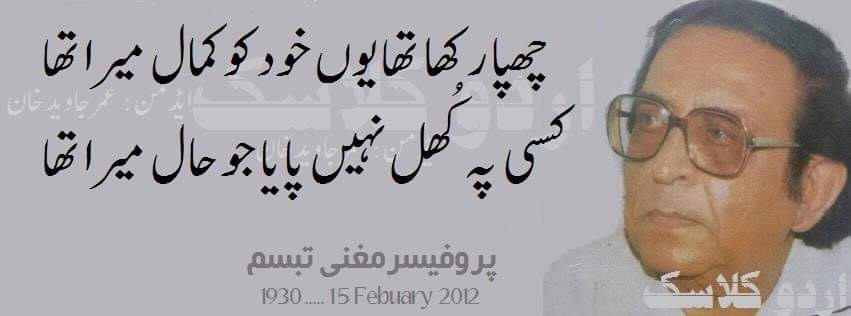
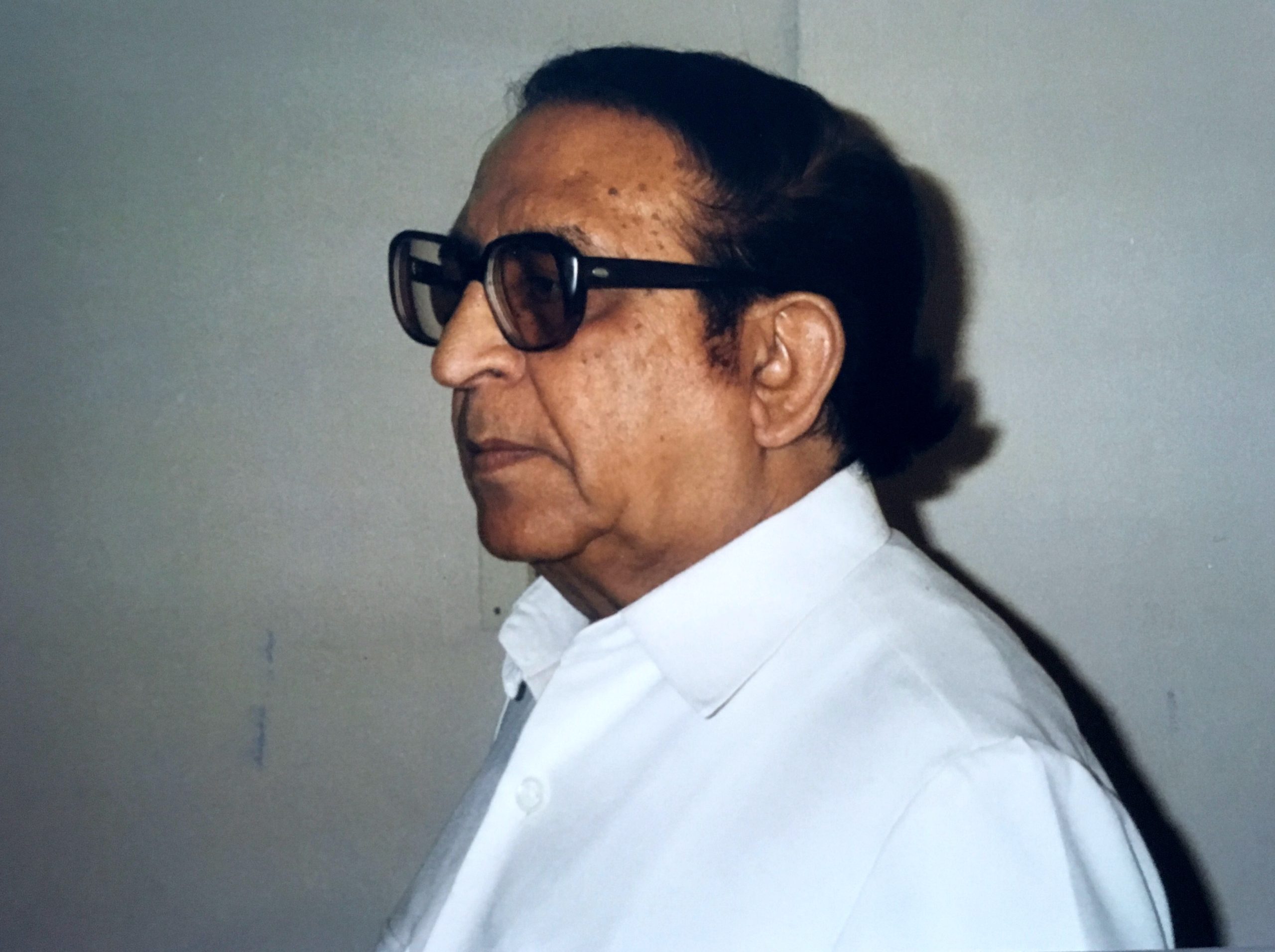
My maternal uncle, Dr Mughni Tabassum (1930–2012)—affectionately known to us as “Mamoojan”—was a towering figure in Urdu literature. He embodied a rare balance of character, seamlessly integrating the rigour of a critic with the soul of a poet. His life was marked by intellectual innovation and deep empathy, qualities that allowed him to navigate the evolving landscapes of academia, editing, and poetry with remarkable grace.
To the family, he was an extraordinary paradox: an iconoclast and a trendsetter who remained perpetually silent, sober, and dignified. He commanded such respect that both young and old approached him with caution. Most family members weighed their words carefully in his presence, fearing they might betray their linguistic shortcomings in Urdu. Even his research scholars often found themselves intimidated, unsure whether to open up to him or remain guarded.
However, I was lucky enough to catch a glimpse behind that door from my childhood. Beneath the scholarly exterior, there was an incredibly compassionate man who brought joy to children with jokes, pranks, candy, and generous “Eidy” during festivals. He was quietly large-hearted, attentive to the needs of the less fortunate, often slipping a few hundred-rupee notes to needy relatives or acquaintances without fanfare.
My love and respect for him deepened when he stayed with us for a few months at our home in Mallepally, Hyderabad. There, I closely observed his enigmatic personality in detail. Contrary to the formidable image he cultivated in literary circles, I found him to be surprisingly domestic. He would occasionally offer to make breakfast for us—eggs, toast, and coffee—a treat we eagerly looked forward to. We discovered he was an inveterate tea drinker, consuming six or seven cups a day, with a thermos always within arm’s reach. He also had a penchant for paan, which he enjoyed sharing with guests.
He found respite in playing cards, especially Rummy. Whenever he had time to spare with friends and family, he played with focus, often emerging as the mysterious winner to the collective dismay of the group.
He was also meticulous about his appearance. Before stepping out, he spent considerable time grooming, insisting on ironing his clothes himself—trusting neither the washerman nor us to achieve the sharp creases he preferred.
His arrival transformed the rhythm of our house. We saw a continuous spate of visitors—peers, admirers, and students—followed by endless rounds of tea and paan. On occasions when poets and litterateurs gathered, I was assigned an unusual task: recording their recitations on a flat-topped tape recorder. It was a duty that allowed me to witness the vibrancy of Hyderabad’s literary culture firsthand.
Professionally, my uncle had a long and distinguished association with Osmania University, rising from Reader to Professor and eventually Head of the Urdu Department at the Arts College. Once, while pursuing my M.Sc. in Geology at the Science College, I paid him a surprise visit. Despite it being lunchtime, his office was packed with faculty and researchers. Yet, when he saw me, he lifted his head, smiled, and gestured for me to sit, warmly introducing me to everyone in the room.
He took immense pride in my career. When I cracked the Civil Services Exam and joined the Indian Foreign Service, he hosted a lavish party for his literary friends. Later, as the head of our maternal family, he participated enthusiastically in all my wedding ceremonies.
Our bond grew stronger as my career took me around the world. Once, while visiting him at the Idara-e-Adabiyat-Urduin Hyderabad, where he served as Secretary, I mentioned I was going to Aurangabad for training. He immediately illuminated the city’s significance as the cradle of Dakhni Urdu, listing contemporaries like Bashar Nawaz, Waheed Akhtar, Qazi Saleem, and Yusuf Nazim. This advice proved invaluable; in Aurangabad, I visited Qazi Saleem and witnessed the cultural impact of his melodic poetry—a poet whose essence my father had also captured in a Khaka.
Over the years, our conversations shifted from familial pleasantries to the preservation of Urdu through digital archiving and translation. In these moments, I was less a civil servant and more an ardent learner.
Though Dr Mughni Tabassum had admirers worldwide, he was a reluctant traveller. He limited his trips to London to see his sister, the poetess Siddiqua Shabnam, or to the US to visit his children. However, I had the privilege of hosting him twice during my postings. First in Doha (September 2000), where he presented a paper on the history of Urdu for the Anjuman Shora-e-Urdu Hind, and later in Jeddah (September 2005) for a “Golden Jubilee Mushaira” organised by the Indian Consulate during my tenure as Consul General.
In Doha, he was deeply moved by the diaspora’s efforts. In a letter to Hassan Chougle, President of the Anjuman, he wrote: “As long as such sincere friends are among the guardians of the Urdu language, we do not lose hope about the future of Urdu”.
Persuading him to attend the Jeddah Mushaira, however, was difficult. He lamented that organisers often favoured “popular” poets who catered to the gallery with their theatrics over serious literary voices. I assured him that we would prioritise acclaimed poets, even if they do not participate frequently in the Mushairas. Thus began a rigorous selection process, narrowing down to a stellar lineup including Shahryar, Saghar Khayyami, Zubair Rizvi, Zafar Gorakhpuri, Hassan Kamal, Siddiqua Shabnam, Noor Jehan Sarwat, Waseem Barelvi, Meraj Faizabadi, Nida Fazli, Dr. Malikzada Manzoor, Talib Khundmeri, Rahat Indori, and, of course, Mughni Tabassum.
The event lasted six hours and left an indelible mark on the connoisseurs of Urdu poetry in the region. Following the Mushaira, my uncle performed Umrah, an experience he described as deeply spiritual. Although he was later honoured with the Aalami Majlis-e-Farogh-e-Adab Award (2007) in Qatar, I could not convince him to visit Jeddah again.
Our literary collaboration persisted in various forms. It was he who sowed the idea of publishing the Kulliyat (collected works) of my father, who passed away in 1995. This dream was fulfilled in 2019 with the release of Kulliyat-e-Awaz Sayeed by the then Vice-President of India, Janab Hamid Ansari. The volume included a foreword by Prof. Gopi Chand Narang. The event was attended by Prof. Narang and the renowned poet Zubair Rizvi, both of whom were contemporaries of my father and uncle.
Even as his health began to decline, my uncle chaired a special session in Hyderabad titled ‘Ek Shaam Awaz Sayeed Ke Naam’. It was a moving tribute to my father, attended by luminaries like Mujtaba Hussain, Iqbal Mateen, Prof. Yousuf Sarmast, and Janab Zahid Ali Khan.
Dr Mughni Tabassum remained the flag-bearer of Urdu until the very end. On February 15, 2012, while I was in Delhi on consultation duty as Ambassador to Yemen, I received the devastating news of his passing. It was a double blow for the literary world, occurring just three days after the death of Shahryar, his close friend and co-editor of the magazine Sher-O-Hikmat. I rushed to Hyderabad to bid farewell to this noble soul.
Returning to Yemen, I was immediately overwhelmed by the unstable security situation of a nation in transition. Yet, amidst the turmoil of diplomacy and conflict, my thoughts kept drifting back to Mamoojan. One of his couplets haunted me, echoing like a prophecy:
Kal mere lafzon mein meri jaan rahe-gi
Duniya jab dekhe-gi to hairaan rahe-gi
“Even after I am gone, my words will breathe with my spirit, And when the world encounters them, it will stand amazed”.
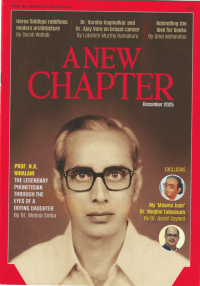
The article was originally published in the December issue of the magazine ‘A New Chapter‘.